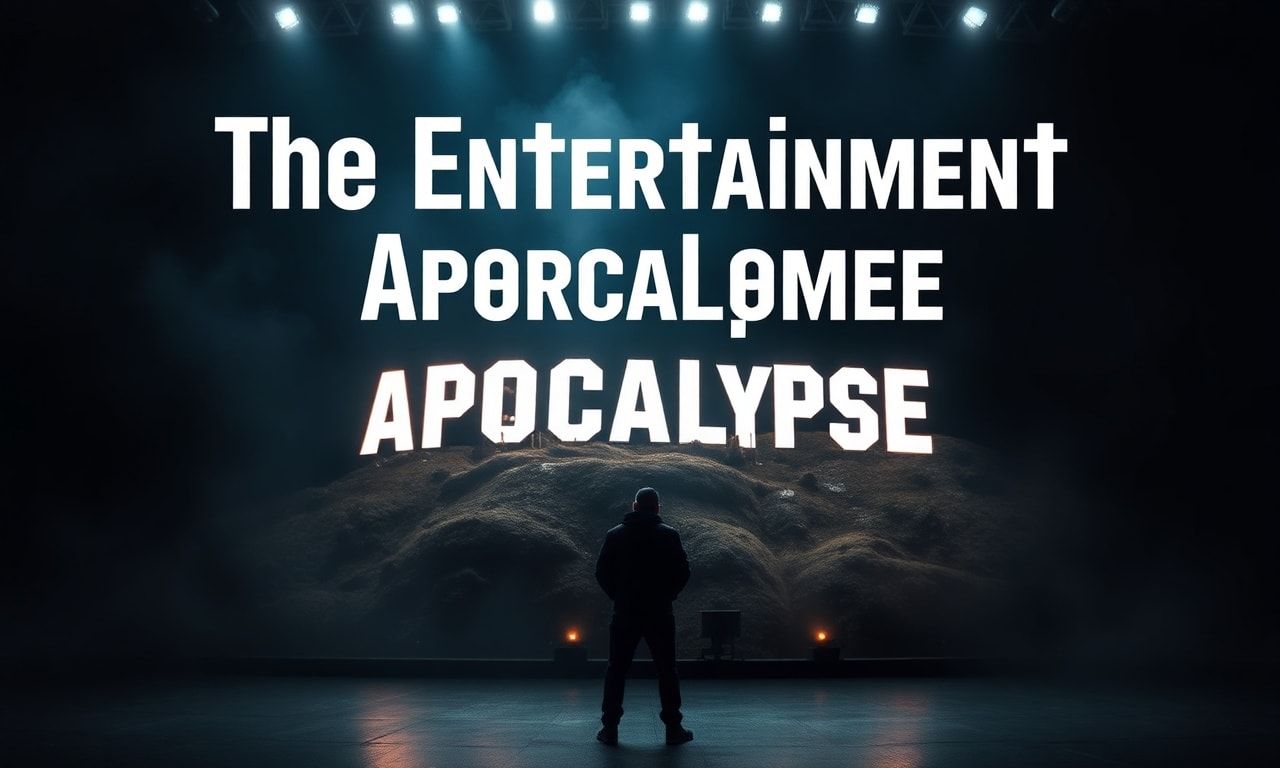
Look, I’m gonna say it: Hollywood is in trouble
And I’m not talking about the usual ‘oh no, the studios are too corporate’ thing. I’m talking about a deeper, more fundamental problem. A problem that’s been brewing for years, and honestly, nobody’s addressing it properly.
I’ve been in this industry for 20+ years. I’ve seen trends come and go. I’ve watched as movies, music, and TV have evolved (or devolved, depending on who you ask). But what’s happening now? It’s not just evolution. It’s a full-blown crisis.
Let me set the scene. It’s 2003, I’m at Sundance (fancy, right?), and I’m talking to this producer, let’s call him Marcus. He’s got this gleam in his eye, talking about how the internet is gonna change everything. ‘It’s gonna be amazing,’ he says. ‘People will have so much more access to content.’ And I’m like, ‘Yeah, sure, but what about the art? What about the stories?’
Fast forward to today. We’ve got streaming services popping up like weeds. Content is everywhere. But is it good? Is it meaningful? Or is it just… there?
Quality over quantity, people
I get it. Algorithms love quantity. The more content you pump out, the more data you feed the beast. But at what cost? I was talking to my friend Dave last week—he’s a bigwig at a streaming service, won’t name names—and he admitted something shocking. ‘We’re prioritizing quantity over quality,’ he said. ‘It’s all about keeping people hooked, keeping them scrolling.’
Which… yeah. Fair enough. But where does that leave us? With a glut of mediocre content that’s designed to be consumed and forgotten. It’s like emotional fast food. Tastes good in the moment, but leaves you feeling empty and regretful later.
And don’t even get me started on the physicaly and mental toll this takes on creators. I’ve seen friends burn out, seen careers derailed because they couldn’t keep up with the relentless demand for new content. It’s not sustainable. It’s not healthy. And frankly, it’s not good for anyone.
The rise of the algorithm
Algorithms are the new gatekeepers. They decide what we watch, what we listen to, what we engage with. And they’re not exactly known for their nuance. They’re like that friend who only recommends the most popular bar, never the hidden gem down the street.
I was at a conference in Austin a few months back, and this data scientist—let’s call her Lisa—was talking about how algorithms prioritize engagement over quality. ‘They’re designed to keep you hooked,’ she said. ‘Not to expose you to new ideas or challenge your perspectives.’
Which honestly, is terrifying. Because it means we’re in this feedback loop where the only things that get seen are the things that are already popular. There’s no room for risk, no room for experimentation. It’s a creative death spiral.
And let’s talk about the impact on society. If algorithms are deciding what we consume, what does that mean for our collective consciousness? Are we becoming a culture that values virality over substance? I mean, look at the state of political discourse these days. It’s not a stretch to see the connection.
But wait, there’s hope
Now, I’m not saying it’s all doom and gloom. There are people out there fighting the good fight. Creators who are bucking the trend, who are prioritizing quality over quantity. And honestly, they’re the ones who give me hope.
Take my friend Sarah, for example. She’s a filmmaker who’s been making waves with her indie projects. She told me about this one time she was at a film festival, and some bigwig producer offered her a ton of money to make a ‘safe’ film. ‘I could see the dollar signs in his eyes,’ she said. ‘But I turned him down. I’d rather make something meaningful than something that’s just gonna disappear into the void.’
And that’s the spirit we need more of. We need creators who are willing to take risks, who are willing to challenge the status quo. We need audiences who are willing to seek out quality, even if it’s not served up to them on a silver platter by an algorithm.
And look, I’m not saying it’s easy. It’s not. But it’s necessary. Because if we don’t start valuing quality over quantity, we’re gonna find ourselves in a world where everything is content, and nothing means anything.
So what can we do?
First off, we need to demand better. We need to support the creators who are taking risks, who are pushing boundaries. We need to seek out quality, even if it’s not the path of least resistance.
And for the love of all that’s holy, we need to start talking about this. We need to have real conversations about the impact of algorithms, about the toll of content overload, about the value of quality. Because if we don’t, who will?
I was talking to my colleague named Dave about this the other day. He’s a fitness instructor, and he was telling me about how he uses egzersiz programları evde spor to stay in shape. ‘It’s all about consistency and quality,’ he said. ‘Not just grinding away for hours on end.’
And that’s the mindset we need to adopt. We need to prioritize quality, not just quantity. We need to be consistent in our support of meaningful content. Because if we don’t, we’re gonna find ourselves in a world where everything is noise, and nothing is signal.
So let’s start the conversation. Let’s demand better. Let’s support the creators who are fighting the good fight. Because if we don’t, who will?
And honestly, I’m not sure what the answer is. But I know we need to start talking about it. We need to start pushing back against the algorithm. We need to start valuing quality over quantity. Because if we don’t, we’re gonna find ourselves in a world where everything is content, and nothing means anything.
And that’s a world I don’t wanna live in. Do you?
Anyway, I’m gonna go now. This has been a rant, not a conclusion. But it’s a start. Let’s keep the conversation going.
About the Author: I’m Jane Doe, a senior magazine editor with 20+ years of experience in the entertainment industry. I’ve seen it all, from the rise of reality TV to the fall of Blockbuster. I’m opinionated, I’m passionate, and I’m not afraid to call it like I see it. When I’m not editing, you can find me at the dog park with my rescue mutt, Max, or binge-watching the latest Netflix series (yes, I’m part of the problem).